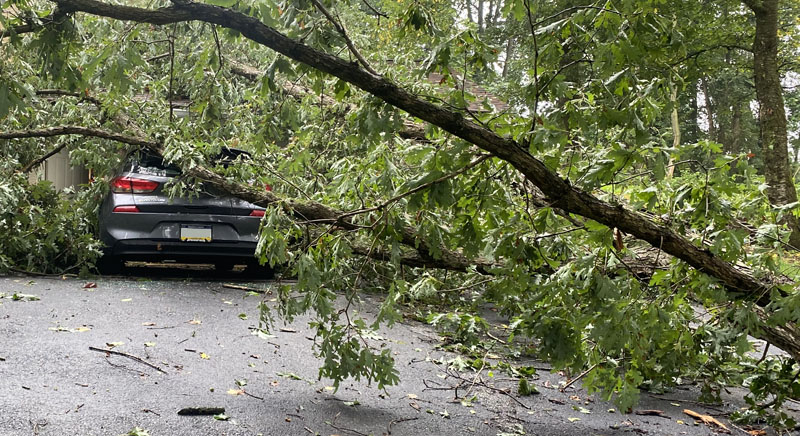
A large tree can be one of the best features on your property. It provides shade, beauty, privacy, and character. But when that same tree starts showing signs of structural weakness or decline, it can quickly become a serious concern, especially if it is close to your house, driveway, garage, fence, or favored outdoor living areas.
Late spring and early summer are a smart time to look more closely at your trees. As leaves fill out, branches get heavier, storms become more frequent, and hidden issues may become easier to spot. A tree doesn’t have to be dead to be dangerous. Sometimes the risk comes from weak structure, storm damage, root issues, or decay that has been developing quietly for years.
If you are wondering whether a tree near your home needs professional attention, here are five signs worth taking seriously.
5 Signs You Should Look Out For That a Tree Near Your Home May Be Dangerous
1. The Tree Is Leaning More Than It Used To
A leaning tree is not automatically a dangerous tree. Some trees grow at an angle naturally and remain stable for years. The bigger concern is a lean that appears suddenly or seems to be getting worse.
A new lean can indicate that the root system has shifted or that the soil around the tree has become unstable. This is especially concerning after heavy rain, strong winds, or construction activity near the tree. If you notice raised soil, cracking ground, or exposed roots on one side of the tree, the situation may be more urgent.
A leaning tree near a home should not be ignored. Even if the canopy still looks healthy, the structure below ground may be compromised.
2. There Are Dead or Hanging Limbs Over Your Home
Dead limbs are one of the most common warning signs homeowners notice, and they are also one of the most practical reasons to call for tree pruning. A dead branch over an open area is one thing. A dead branch over your roof, driveway, deck, or walkway is another.
Watch for branches that are:
- Bare while the rest of the tree has leaves
- Cracked or partially broken
- Hanging loosely in the canopy
- Resting on other limbs
- Dropping bark or smaller twigs
Deadwood can fall without much warning, especially during storms or high winds. Proper pruning can often remove the hazardous material while preserving the tree, but the work should be done carefully so the tree is not damaged further.
3. The Trunk Has Cracks, Cavities, or Decay
The trunk is the main support system of the tree. When it has major cracks, large cavities, soft spots, or obvious decay, the tree may not be as strong as it looks from the outside.
Some warning signs include:
- Deep vertical cracks
- Large holes or hollow areas
- Mushrooms or fungal growth near the trunk
- Missing bark that does not appear to be healing
- Soft or crumbly wood
- Insect activity around decayed areas
A cavity may not mean a tree has to be removed. Many trees can live for years with some internal decay. The concern is whether enough strong wood remains to support the tree safely, especially during strong wind or severe storms. That is where an assessment from a Professional Arborist or trained tree care professional becomes important.
4. The Tree Has Multiple Trunks or Weak Branch Unions
Some trees naturally develop multiple trunks or large competing stems. These are often called codominant stems. The risk comes from the way those stems connect.
When two large trunks or limbs grow tightly together, bark can become trapped between them instead of forming a strong wood connection. This is called included bark, and it can make the union more likely to split under stress.
This type of weakness is especially concerning when:
- The split point is close to the main trunk
- Large limbs extend over your house or driveway
- The tree has already cracked in the union
- One side of the canopy is much heavier than the other
- The tree has a history of storm damage
In some cases, cabling and bracing may help support an at-risk tree you want to keep. In other cases, pruning or removal may be the safer option. The right answer depends on the tree, the target area, and the severity of the structural issue.
5. Roots or Soil Around the Tree Look Disturbed
A tree’s stability depends heavily on its root system. Unfortunately, root problems are often overlooked because they are not as visible as broken limbs or trunk cracks.
Look around the base of the tree for signs like:
- Soil lifting or cracking near the trunk
- Exposed roots that look damaged or decayed
- Recent trenching, grading, or construction nearby
- Soil that stays overly wet or compacted
- A buried root flare from excess mulch or soil
- Fungal growth around the base of the tree
If the base of the tree is hidden under a mulch volcano, it may be harder to see what is happening. Mulch piled against the trunk can hide root collar problems and contribute to long-term decline. The root flare should be visible, not buried.
Learn more about this tree care no-no, the mulch volcano.
Root issues are especially important when the tree is close to a house. A compromised root system can make the entire tree less stable, even if the canopy still appears full and green.
What Should You Do If You Notice These Signs?
The first step is simple: do not panic, but do not ignore it either.
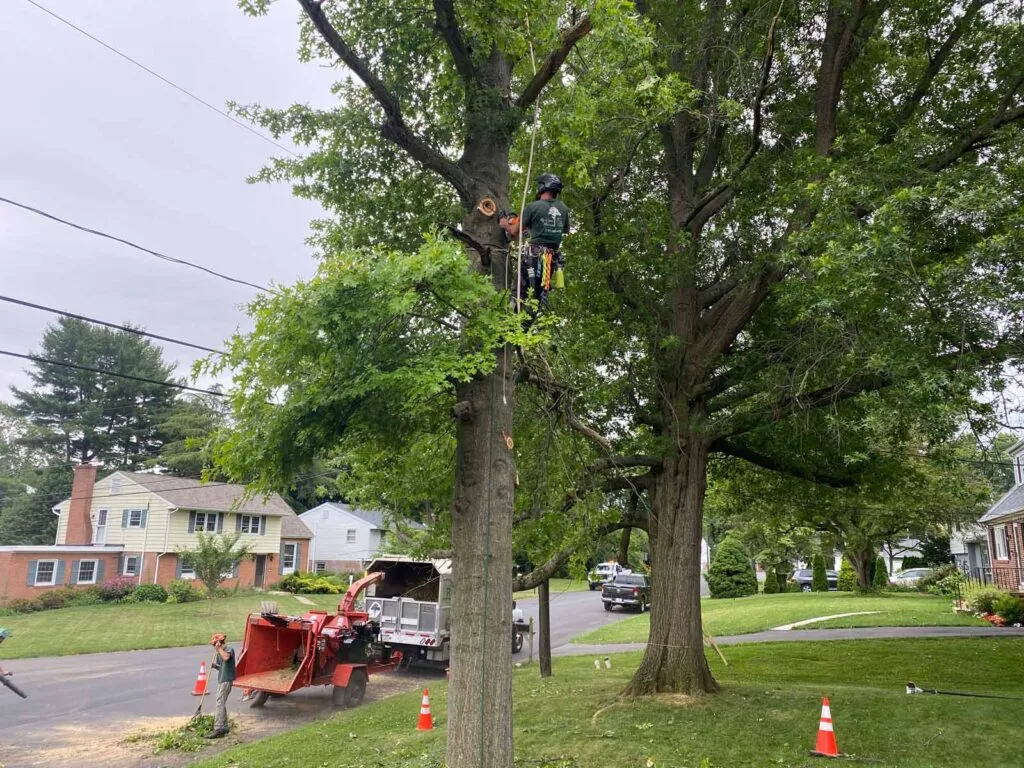
A dangerous tree should be assessed before it becomes an emergency. This could mean removal, but not always. Sometimes pruning, cabling and bracing, plant health care, or root collar care may help reduce risk and preserve the tree. Other times, removal is the responsible choice.
You should call a tree care professional if:
- A large limb is hanging over your home
- The tree has developed a sudden lean
- You see cracks, decay, or fungal growth
- Storm damage has changed the tree’s structure
- You are unsure whether the tree can be safely preserved
The sooner you get answers, the more options you usually have.
Why Homeowners in Lancaster and Chester County Should Pay Attention Before Summer Storms
In May and June, trees are carrying more leaf weight, spring rain can soften soil, and thunderstorms can put extra stress on already-weakened limbs and trunks. If a tree near your home is showing warning signs now, waiting until peak storm season may limit your options and increase the chance of damage.
Reaching Higher specializes in large trees, limited-access work, professional pruning, tree removal, cabling and bracing, and storm cleanup. If you are worried about a tree near your home, our team can assess the situation and help you understand the safest next step.
Worried About a Tree Near Your Home?
If something looks off, it is worth getting a professional opinion before the next storm tests it. Reaching Higher can inspect the tree, explain your options, and recommend a practical plan based on safety, access, and the condition of the tree.