Getting a tree removed or pruned is a big project that requires planning, skill, and the right equipment. If you’re thinking about hiring a tree service company, you probably have a few questions you’d like answered first.
We’ve done our best to cover the most common questions we receive. If you can’t find the right answer below, call 717-502-4707 or reach out through our contact page.
There are many important things to consider when choosing a tree service company, but these tend to matter most:
Tree removal costs vary widely, from a few hundred dollars to several thousand per tree depending on the size, access, risk, and complexity. If you’d like a deeper breakdown, you can refer to our tree removal cost blog. Reach out today for a free tree removal quote.
Tree pruning costs vary depending on the tree and the type of pruning needed. It is often less expensive to prune a tree than remove it, but professional pruning can still be a significant project. Give us a call for a free tree pruning quote.
Stump grinding cost can vary depending on stump size and access. In some cases, we can quote stump grinding quickly if you can provide:
Give us a call at 717-502-4707 and we can help you get a stump grinding quote.
One simple way to reduce cost is to do less work. Another is to adjust cleanup. For example, leaving brush and debris onsite can reduce time and hauling. If you want a “no cleanup” option, let us know and we can quote it that way.
Call or text 717-502-4707, send us an email, or reach out through our website. We typically need your name, address, phone number, and an email address for sending the quote (if you have one). We’ll also need the location and a description of each tree (whatever you know is fine). Once we have that, we can visit within a few days and send your quote. You do not need to be home unless you want to meet the technician.
Approve the quote and submit a deposit if one is requested in the proposal. Once approved, we’ll get your project on the schedule and notify you ahead of time when your job is coming up.
Yes. We accept major credit cards and can take payment online. We also accept cash and checks.
No. Many customers prefer not to be home. As long as we have clear access and clear instructions, we can complete the work and follow up afterward.
We are fully insured and can provide proof of insurance with your quote.
Pennsylvania does not issue a general “tree service license,” but pesticide applications do require proper licensing. Reaching Higher is licensed for pesticide application services when treatments are needed as part of services like Plant Health Care and Spotted Lanternfly Treatment. You can make sure your current service provider is licensed by checking with the state of PA here.
Pennsylvania does not typically require tree services to be bonded except for specific government projects, so we do not carry performance bonds.
We service Lancaster and Chester Counties in Pennsylvania, including areas such as Gap, Parkesburg, Coatesville, West Chester, Downingtown, Lancaster, Manheim, Quarryville, and Kennett Square.
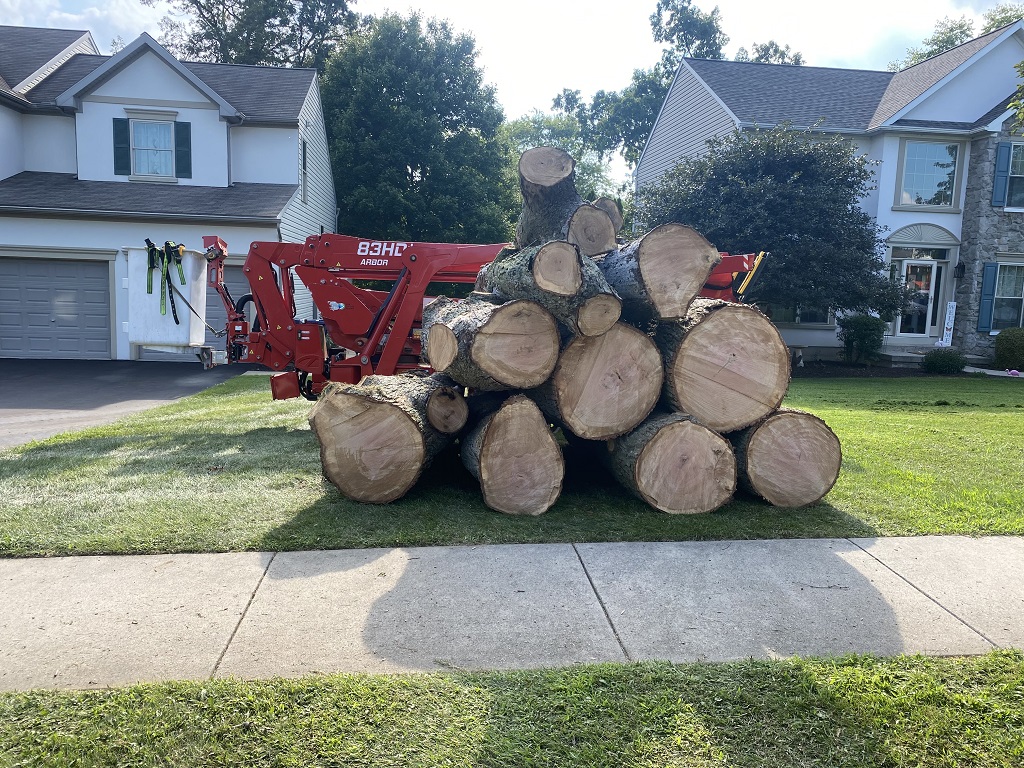
Creatively. We use climbers, specialty backyard lifts on narrow tracks, and cranes that allow us to reach trees in backyards. It’s rare that we encounter a tree we cannot safely access.
It depends. We can often work around the lines that feed a house, but high-voltage lines along the street have stricter safety and legal limitations. When needed, we can work with the utility company so the job can be handled safely and correctly.
Most likely. Limited access is something we plan for. We use climbers, specialty lifts that can fit through a 36-inch gate, and cranes for difficult trees. Just keep in mind: the harder it is to access the tree, the more complex (and often more expensive) the job can be.
It depends on the species, age, and location. Some fast-growing or ornamental trees benefit from annual pruning, while others may only need attention every 3 to 5 years. We can help you build a plan that fits your trees and your property.
No. Topping is one of the worst things that can be done to a tree and often creates long-term problems, including decay and weak regrowth. A tall tree is not dangerous simply because it is tall, but it will be dangerous once the decay sets in after topping, and the new growth starts coming out. Most topped trees are actually taller 5-10 years afterward than they were before topping. The PennState Extension has a great article here about why you should never top a tree
Trees decline and die like any other living organism. Sometimes a tree has reached the end of its natural life. Other times it may be affected by disease, insects, mites, or fungi. Some issues are treatable if caught early enough.
Give us a call and let a professional arborist take a look.
A full canopy and a strong trunk are a good sign, but not a guarantee. Some problems require a trained eye to spot, such as:
To be sure, give us a call and let us send a trained tree care professional to assess your trees.
We do our best to minimize impact, but lawn disturbance can happen because trees and equipment are heavy. Ground protection mats are available as an option to help reduce impact. Driveway damage is uncommon, but any surface can be vulnerable if it is already in poor condition.
Yes. We remove the debris we create unless you want something left behind.
Of course. It’s your tree. If you want to keep wood, let us know during the estimate so we can plan the best way to leave it for you.
We may use a contracted log hauler for pickup. If that applies to your job, we will coordinate the logistics so you don’t have to.
We recycle chips for beneficial use such as mulch and other wood products.
You can leave them to decompose, use them as mulch elsewhere, or remove them if you want to plant in that spot. Cleanup and restoration can also be arranged as an option, such as bringing in topsoil and seeding.
We do not sell firewood. In some cases, we may have logs available if you can take a full log-truck load.
Often, yes. There may be roots to work around, but it’s usually possible. We can also recommend a local professional if you’d like help with planting.
Yes. We offer Spotted Lanternfly Treatment, and our Plant Health Care services can include targeted insect and disease treatments when appropriate. We can inspect your trees and shrubs, identify the issue, and recommend the right next steps, including properly timed, licensed treatments when needed.
Maybe, but often not. Requirements vary by municipality, so it’s a good idea to check with your local office if you’re unsure.
Call 717-502-4707 or reach out through our website to get the answers you need and request a quote.