Tree removal is not something most homeowners schedule often, which makes the whole process feel a little mysterious. One company may show up with a chainsaw and a pickup truck. Another may bring a full crew, specialized equipment, ground protection, rigging gear, and a clear plan for protecting your property.
Those are not the same experiences.
If you have a dead, damaged, leaning, or poorly located tree near your home in Lancaster, PA, knowing what to expect can make the process much less stressful. A professional tree removal should not feel chaotic. It should feel planned, controlled, and clearly communicated from the first call to the final cleanup.
Step 1: You Request a Quote
The process usually starts when you call, text, email, or request a quote online. To help the tree care team understand the situation, be ready to share a few basic details.
Helpful information includes:
- Your name and property address
- Where the tree is located on the property
- Whether the tree is dead, leaning, damaged, or close to a structure
- Any access concerns, such as a fence, narrow gate, slope, or tight driveway
- Whether the tree is near power lines
- Photos, if you can safely take them from a distance
You don’t need to diagnose the tree yourself. Simply give enough information so the tree service company can understand what kind of project they may be looking at.
Step 2: A Tree Care Professional Assesses the Tree
Before a tree is removed, it needs to be assessed. Reaching Higher will look at the tree itself, the surrounding property, access points, nearby structures, and any hazards that could affect the removal.
During this assessment, the technician or Professional Arborist may look for:
- Dead or declining limbs
- Cracks, cavities, decay, or missing bark
- A new or worsening lean
- Root plate movement or soil lifting
- Proximity to homes, garages, fences, driveways, and utilities
- Whether pruning, cabling, treatment, or removal is the best option
Not every damaged tree needs to come down. Sometimes professional pruning, cabling and bracing, plant health care, or root collar care may be enough to reduce risk and preserve the tree. Other times, removal is the safest and most practical choice.
Step 3: You Receive a Clear Recommendation and Quote
Once the tree and property are assessed, you should receive a recommendation and pricing. A good quote should help you understand what work is being done, what services are included, and what additional options are available.
Tree Removal pricing can vary based on:
- Tree size and condition
- Location and accessibility
- Whether the tree is near structures or utilities
- Rigging complexity
- Equipment needed
- Cleanup and hauling preferences
- Whether stump grinding is included or added as an option
Stump grinding is commonly requested after removal, but it is still a separate service that involves its own equipment. Cleanup, hauling stump grindings, and restoring the area with topsoil or seed/sod may also be available as additional options depending on what you want the finished space to look like.
Step 4: The Crew Plans the Safest Removal Approach
Professional tree removal is not just cutting down a tree. In many residential areas of Lancaster, trees are close to homes, fences, garages, driveways, patios, and landscaping. That means the crew needs a controlled plan.
Depending on the tree and site, removal may involve:
- Climbing and rigging
- Carefully lowering limbs in sections
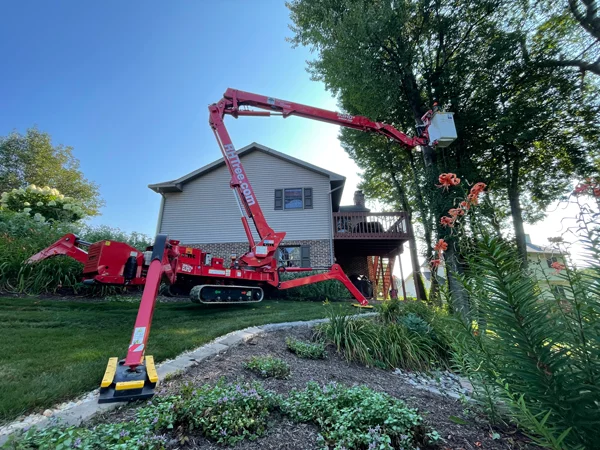
- Using lifts or specialized access equipment
- Crane-assisted removal for larger or difficult trees
- Ground protection to help reduce lawn impact
- Traffic or pedestrian awareness when working near roads or sidewalks
Penn State Extension notes that storm-damaged trees and large tree work can be hazardous, and homeowners should be cautious about chainsaw work or hiring uninsured, fly-by-night help after damage occurs: https://extension.psu.edu/helping-trees-recover-after-storms/
Tree removal is technical work, and the safest approach depends on weight, tension, structure, access, and what is around the tree.
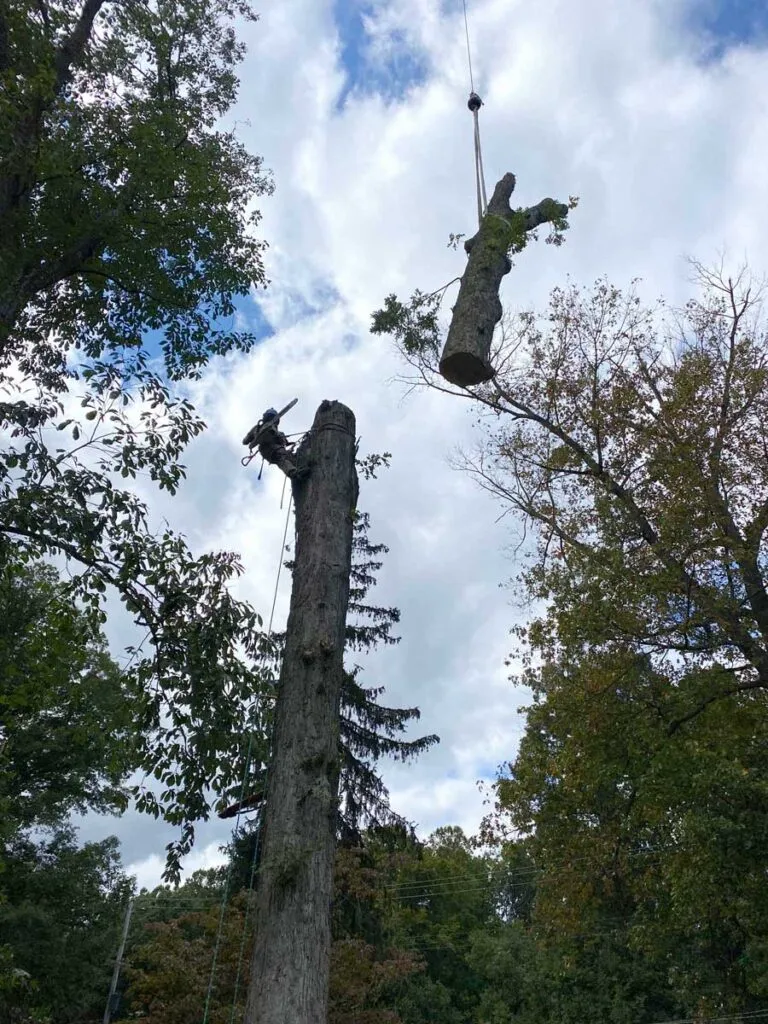
Step 5: The Tree Is Removed in Sections
In tight residential spaces, trees are usually removed piece by piece. Large limbs may be cut and lowered with ropes, rigging systems, lifts, or cranes rather than simply dropped.
This controlled approach helps protect:
- Roofs and gutters
- Fences and sheds
- Driveways and walkways
- Landscaping and lawns
- Nearby trees and shrubs
- Vehicles and outdoor living areas
Large trees and limited-access jobs are a specialty for Reaching Higher. If another tree company has said a tree is hard to reach, that doesn’t automatically mean it can’t be removed. It may mean the job needs better planning, different equipment, or a more experienced crew.
Step 6: Brush, Logs, and Debris Are Handled
After the tree is down, the crew handles the debris based on what was included in your quote. In many cases, branches, brush, and logs are removed unless you’ve requested otherwise.
Some homeowners choose to keep wood for firewood or have logs left on site. Others prefer full cleanup and haul-away. The important thing is to clarify that during the estimate so the quote matches your expectations.
For larger logs, pickup may sometimes be coordinated separately. If that applies, the tree service should communicate what to expect and when the material will be removed.
Step 7: Stump Grinding May Be Added
Tree removal leaves the stump behind unless stump grinding is included or added. Grinding the stump helps eliminate a trip hazard, improve the look of the space, and make the area easier to use again.
After stump grinding, the remaining grindings can be left on site or cleaned up depending on your preference and the quoted scope. Restoration options, such as adding topsoil and seed/sod, may also be available if you want the area finished more cleanly.
What Should You Do Before the Crew Arrives?
A little preparation can help the job go smoothly.
Before your scheduled tree removal, consider:
- Moving vehicles out of the work area
- Unlocking gates or clearing access points
- Moving patio furniture, grills, toys, or planters if needed
- Keeping pets and children indoors or away from the work zone
- Letting the crew know about underground utilities, irrigation, or septic concerns
- Confirming whether you want wood, chips, or grindings left behind
You don’t need to overthink it. Most tree care companies will provide you with some instruction of what to do ahead of time, and the crew will handle the technical work. Your job is to make sure access is clear and expectations are communicated.
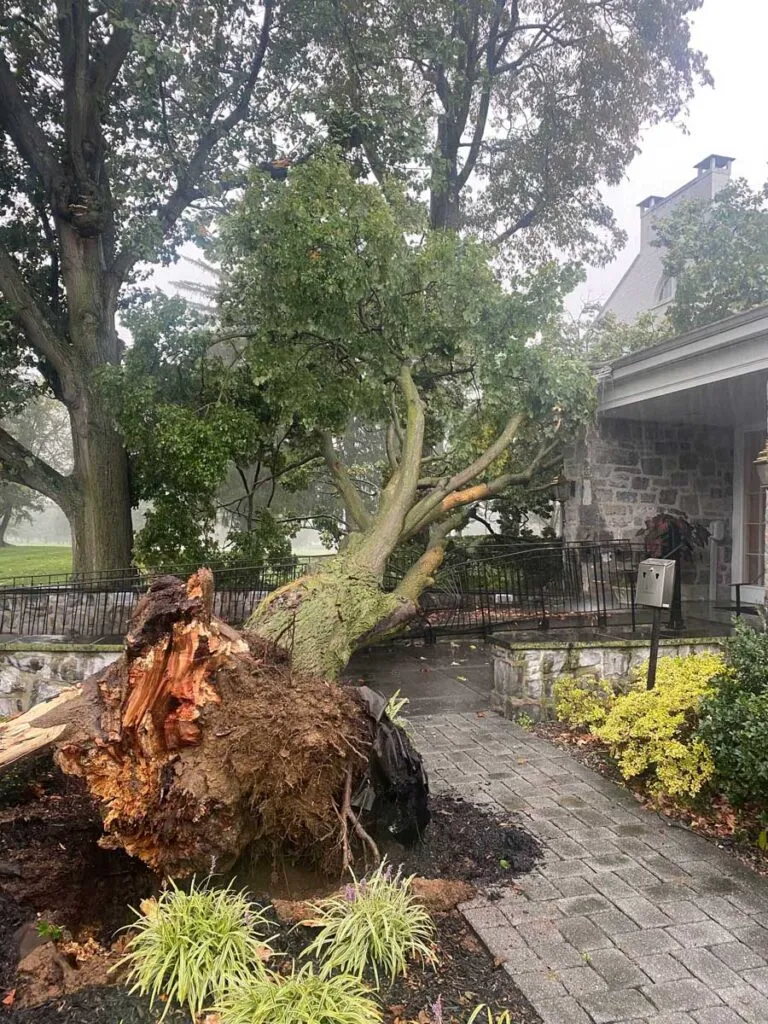
When Tree Removal Becomes an Emergency
Some removals can be scheduled after a normal assessment. Others require immediate attention.
Call for Emergency Tree Service if:
- A tree has fallen on your home, garage, vehicle, or fence
- A large limb is hanging over your roof or driveway
- A tree is suddenly leaning after a storm
- A tree is blocking access to your property
- Utility lines may be involved
If power lines are down or a tree is touching wires, stay away and call the utility company or emergency services as needed. For emergency tree service with Reaching Higher, call 717-502-4707.
Ready for Professional Tree Removal in Lancaster, PA?
A professional tree removal should be safe, organized, and clearly explained. From the first assessment to the final cleanup, Reaching Higher focuses on careful planning, controlled work, and communication you can trust.
If you have a dead, damaged, leaning, or poorly located tree on your Lancaster property, request a free quote or call 717-502-4707 to get started.